


M. Sc. Jochen Illerhaus
- Research Associate
- Group:
- Room: 201/2
- Phone: +49 721 608-42471
- Fax: +49 721 608-42707
- jochen illerhaus ∂does-not-exist.kit edu
Karlsruher Institut für Technologie (KIT) Campus Süd
Institut für Regelungs- und Steuerungssysteme
Geb. 11.20 (Engler-Villa)
Kaiserstr. 12
D-76131 Karlsruhe
Physics-informed control systems combined with thermal energy storage enable efficient use of renewable energy at the district level by optimally coordinating generation, consumption, and storage.
Curriculum Vitae
| 2012-2015 | German Abitur, majoring in mechatronics at Technisches Gymnasium Ravensburg in Ravensburg, Germany. Graduated with distinction. |
| 2015-2016 | General Studies at Lindenwood University in St. Charles, Missouri, USA. Left with excellent grades and distinctions but without graduation. |
| 2017-2024 | Tutor for Advanced Mathematics 1 to 3 for Bachelor students of Electrical Engineering and Physics at the Institute of Analysis at the Karlsruhe Institute of Technology. Most recently, execution of the first practical trials for hall tutorials. |
| 2019-2020 | Internship in the development of driver electronics for automotive lights at Xingyu Atomotive Lighting Systems in Changzhou, China. |
| 2019-2020 | Bachelor's thesis entitled “Market-based operation of 4th generation heating networks” at the Institute of Control Systems at the Karlsruhe Institute of Technology. |
| 2016-2021 | Bachelor of Science in Electrical Engineering and Information Technology at the Karlsruhe Institute of Technology. Electives from the field of super-conduction. |
| 2017-2021 | Successful completion of the courses on Theoretical Physics for Bachelor students of Physics. |
| 2020-2022 | Student assistant at the Institute for Control Systems at the Karlsruhe Institute of Technology, focusing on the simulation and optimal operation of district heating networks. |
| 2023-2024 | Master's thesis entitled “Passivity Based Reinforcement Learning” at the Institute of Control Systems at the Karlsruhe Institute of Technology. |
| 2021-2024 | Master of Science in Electrical Engineering and Information Technology, with study model Control Systems at the Karlsruhe Institute of Technology and a final grade of very good. |
| since 2024 | Research Associate with the Control Systems Professorship at the Institute of Control Systems, Karlsruhe Institute of Technology (KIT), under Prof. Dr.-Ing. Sören Hohmann. |
Research
Thermodynamic Control of Modular Energy Networks
Photovoltaics are already a cost-effective and low-carbon source of energy. However, their output varies over the course of the day and across seasons. As a result, future energy systems will be characterized by periods of near-abundant availability and times when electricity must be used efficiently as a scarce resource. Demand-side flexibility can play a key role in addressing this challenge. One major consumer in this context is space heating. While new buildings achieve low energy demand through advanced insulation, comprehensive retrofitting of existing buildings is often prohibitively complex. Climate-friendly heating solutions that do not require major structural modifications are therefore urgently needed.
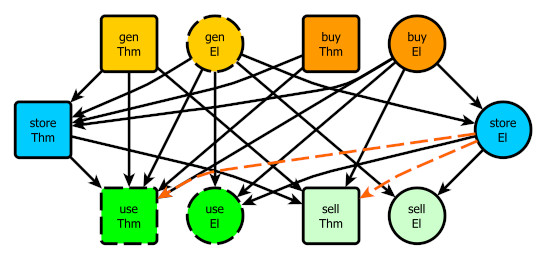
Intelligent control systems are a central component in this context. They determine when and where energy should be generated, used, transported, or stored. A key advantage is that they rely only on low-cost sensors and minimal additional hardware, making them easy to deploy, cost-effective, and suitable for retrofitting. Such approaches are particularly promising at the district level, where medium- to large-scale thermal storage can be implemented and even small efficiency gains quickly become economically viable at scale.
Challenges and Methods
Documentation on existing buildings and heating networks is often incomplete or unavailable. As a result, self-learning approaches are of great importance. Typically, large training datasets are not available; instead, relevant data must be collected during operation, making efficient data usage essential. At the same time, it is neither practical nor desirable to learn fundamental physical relationships purely from data. Physics-informed learning methods address this by incorporating known physical principles as prior knowledge, while only learning the unknown aspects from data.
In addition, such systems are distributed networks with a potentially large and time-varying number of components. Scalability is therefore a key requirement. Modular approaches are particularly well suited to this setting and can be systematically analyzed using passivity theory. Long-term storage, operating over extended time horizons, introduces numerical challenges. Structure-preserving integration methods and differential geometric formulations provide a promising framework to address those challenges.
D²HeaTEC Project
The joint project D²HeaTEC (Decarbonizing District Heating with Techno-Economic Control) develops and evaluates an integrated control framework that coordinates both technical and economic aspects of decentralized, renewable heat supply. Two residential districts in Cologne serve as testbeds, enabling a direct comparison between natural gas-based heating systems and electric heat pumps.
The thermal systems are modeled and techno-economically controlled. The system model includes representations of generation units, distribution networks in both districts, and a modular apartment model. While generation and distribution are already monitored in real time, additional devices such as radiator actuators, heat cost allocators, and indoor air sensors will be installed in participating apartments specifically for this project. All data is aggregated in a pseudonymized form.
The control framework has access to these aggregated data and thus addresses a fundamental limitation of conventional systems: so far, residents, landlords, and network operators at best optimize within their respective local scope. The proposed approach overcomes this fragmentation.
Collaboration
If you are interested in research collaborations, theses, internships, or student assistant positions, feel free to get in touch. In addition to the listed opportunities, there are always further exciting and current topics available.
| Title | Type |
|---|---|
| Identifikation linearer dynamischer Modelle zur Vorhersage von Raumtemperaturen | Bachelor-/Master Thesis |
| Lineare modellprädiktive Regelung intelligenter Thermostate für vernetzte Wohnungen | Bachelor-/Master Thesis |