

Automated Generation of Motion Planning Constraints for Cooperative Tasks
- Type:Master's thesis / Bachelor's thesis
- Date:ASAP
- Supervisor:
- Links:Tender
-
Developing a software architecture that automatically generates parameterized motion planning constraints for cooperative robot-robot tasks.
MOTIVATION:
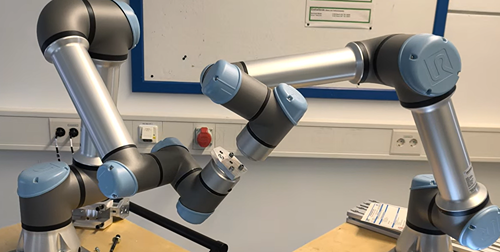
New, state-of-the-art motion-planning methods are making it easier than ever to create robot trajectories automatically for simple tasks. However, real production tasks are rarely simple. Even with today's state-of-the-art motion-planning tools, real production tasks are still hard to automate. Multi-step processes, changing conditions, and the need for two or more robots to work together create a huge number of dynamic motion constraints. Right now, engineers must program every one of these constraints by hand—an extremely technical, time-consuming, and inflexible process. When something changes, the code must often be rewritten from scratch.
In this thesis, you will develop an architecture that automatically generates the motion-planning constraints needed for cooperative robot tasks. Instead of forcing developers to specify every mathematical detail, your system will take a higher-level description of the constraints and turn it into the correct mathematical formulations on demand. Your work can build on the MoveIt framework for ROS (Robot Operating System), and you'll test your solution both in simulation and on real robots. Your architecture will make cooperative robot programming more flexible, reusable, and far easier to adapt. It reduces tedious coding, boosts automation, and allows production cells to adjust to new requirements without major rework. By the end of the project, you'll be able to demonstrate your system in real, industry-inspired scenarios, showing how automatic constraint generation can push cooperative robotics toward a more autonomous and scalable future.
GOALS:
- Analysis of modern motion planning pipelines and their limitations.
- Formalization of abstract mathematical constraints for cooperative tasks.
- Development of an architecture that composes and parameterizes usable constraints for a motion planning task using the information and references of a system.
HELPFUL PRIOR KNOWLEDGE:
- Interest in robotic industrial processes
- Ideally programming skills in Python and/or C++
- Knowledge in robotics, particularly motion planning beneficial