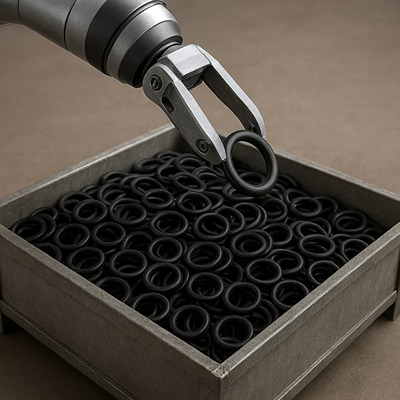
Development of Singulation Strategies for Flexible and Deformable Components
- Subject:Singulation, automation, flexible and deformable components
- Type:Bachelor's Thesis
- Date:ASAP
- Supervisor:
- Links:Tender
-
Bachelor's thesis on the development of various concept strategies for the automated singulation of highly deformable rubber components.
MOTIVATION:
The automation of assembly processes is a key element of modern manufacturing systems. However, significant challenges remain when handling flexible and deformable components, as their low stiffness and high shape variability complicate reliable manipulation. This is particularly true for elastic rubber components, whose position and shape can be strongly influenced by external factors during handling.
As a result, the assembly of such components is often still performed manually in industrial applications. Reliable singulation is a fundamental prerequisite for automated assembly processes. While numerous established solutions exist for rigid components, suitable singulation methods for flexible parts remain limited. The development of appropriate strategies is therefore an essential step toward the automation of these processes.
Against this background, this thesis focuses on the development and evaluation of singulation strategies for flexible and deformable components.
OBJECTIVES:
The objective of this bachelor's thesis is the development and systematic evaluation of strategies for the singulation of flexible and deformable components using elastic sealing elements as a representative use case.
First, the specific characteristics of flexible components and the resulting challenges for automated handling processes will be analyzed. Based on this analysis, different technical approaches for singulation will be identified, evaluated with respect to their suitability, and compared using a structured requirements specification.
Subsequently, suitable singulation strategies will be developed and elaborated on a conceptual level. Particular attention will be paid to process reliability, gentle handling of the components, integration into automated assembly processes, as well as technical and economic feasibility.
USEFUL PRIOR KNOWLEDGE:
- Basic understanding of mechanical design and engineering design principles
- Interest in automation technology
- Strong interest in mechatronic machine components